Aki no koe – the voice of autumn
It’s the first week of August in the Hudson Valley and the crickets have begun to sing. Their song surrounds the Tea House in waves, as though we’re floating on an ocean of cricketing.
Their song is the voice of autumn and reminds me of this phrase from the Cold Mountain Poems of Han Shan.
Crying in the dew, a myriad of grasses
Singing in the wind, a single chorus of pines.
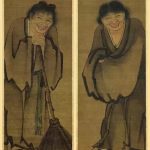
Cold Mountain is a collection of 310 poems written twelve hundred years ago on the rocks, trees, and temple walls of China’s Tientai Mountains. Han Shan and his friend Shi-de (Japanese: Kanzan and Jittoku), active in the late 8th-early 9th century, were Zen Buddhist monks. Han Shan was a hermit and he begged for food at temples, often sang and drank with cowherds, and became an immortal figure in the history of Chinese literature and Zen. Shi-de was Han Shan’s constant companion, and the temple’s janitor. He is usually depicted carrying a broom. They appear frequently in Zen paintings, representing the rejection of the secular world and the search for enlightenment.
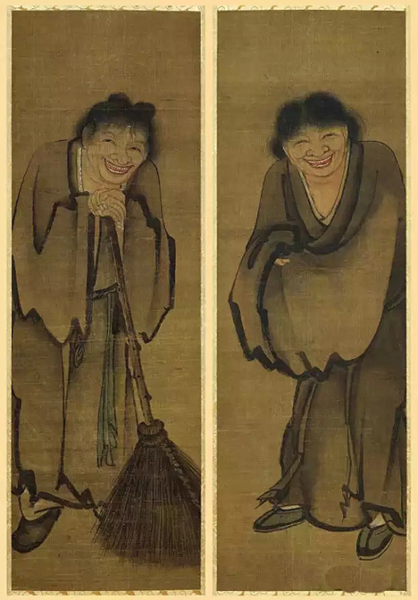
They are quintessential Zen men, usually laughing together, wandering carefree, and enjoying each moment as it is.
Gary Snyder, one of the first Americans to go to Japan to study Zen in the fifties, translated the poems in his book Rip Rap and Cold Mountain Poems. They were the first Zen poems I ever read.
I wanted to be Han Shan. I wanted to live as he did. It was the 70s and my friends and I left the cities, regular jobs, and normal lives. Some of us lived in teepees nestled in alpine meadows, others lived in cabins that lined the side of a dirt road in an abandoned logging camp high up in the mountains. I looked for an old cabin on the back side of Ajax Mountain in Aspen so I could live far from the world like Han Shan. I dreamed I would hike in my food for the week and heat the cabin with wood gathered in the summers. Like Han Shan’s home, there would be a one track path to my place. In the mountains the vastness of space and light gave me a glimpse of something I longed to know more of. If I lived like Han Shan I might find it.
I was eighteen. Out of school. No money. My mother said “Come back home. You can’t live a life of Zen out there.” Or maybe she said, “You can’t live a life of Zen.” At that time I had no idea what Zen was, nor did she. I came home to the city, got a job and eventually found my way to NY Zendo on the upper east side of Manhatten. As soon as I sat down on the cushion, crossed my legs, and breathed into the the deep silence I knew this was what I was looking for. It was home. It was Cold Mountain.
The path to Han-shan’s place is laughable,
A path, but no sign of cart or horse.
Converging gorges – hard to tracec their twists,
Jumbled cliffs – unbelievably rugged.
A thousand grasses bend with dew,
A hill of pines hums in the wind.
And now I’ve lost the shortcut home,
Body asking shadow, how do you keep up?
Mono no aware
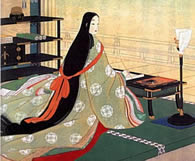
Sei Shonagon’s writings are filled with what the Japanese call “aware,” a poignant nostalgia for the past. It’s a melancholy, sweet ache that is almost beautiful. I feel it strongly in the late summer with the appearance of the crickets and cicadas in my garden. Summer is fading and soon we will be entering the long dark evenings and short cold days of winter.
I went away in the midst of this summer for three weeks. I knew the garden would grow unruly without my daily care but I didn’t think it would be too much, so I wasn’t worried. Before leaving, I cleaned the house and then went out to the Tea House. In the summer, if it’s humid, the tatami mats get moldy – green slimy mold on them, so I set the ceiling fan on low and removed the scroll that was hanging in the tokonoma alcove. I rolled it up and brought it inside my house where it was sure to be safe. The Tea House was bare and empty.
When I returned from vacation, the garden had grown more wild than I ever expected. It had rained constantly throughout July, something it hadn’t done in years. Weeds were three feet high, the grass had to be weed-whacked before it could be mowed. In Switzerland, where we had gone hiking near the Eiger Mountain in the Bernese Alps, I saw an old woman with long gray hair scything her small field. That was me back home with my weed whacker.
The hot, rainy month of July has ended and now in an unusual cooling with the full moon the crickets have started their mating with sounds like waves of chirping in the long deep slide from late evening into darkness.
I went out to the Tea House and opened all the windows and turned off the fan. The space felt empty and I realized that what makes it vibrant and alive besides the incense and people sitting together is the scroll, the calligraphy in black ink drawn by my teacher and other Zen masters. I’m lonely without them.
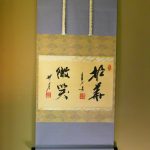
I look for a scroll. Which words do I choose to convey this sentimental melancholy that I’m feeling? Who do I turn to? I miss my teacher who died five years ago. I pick a scroll that he had mounted for me. I hang it in the Tokonoma and sit down.
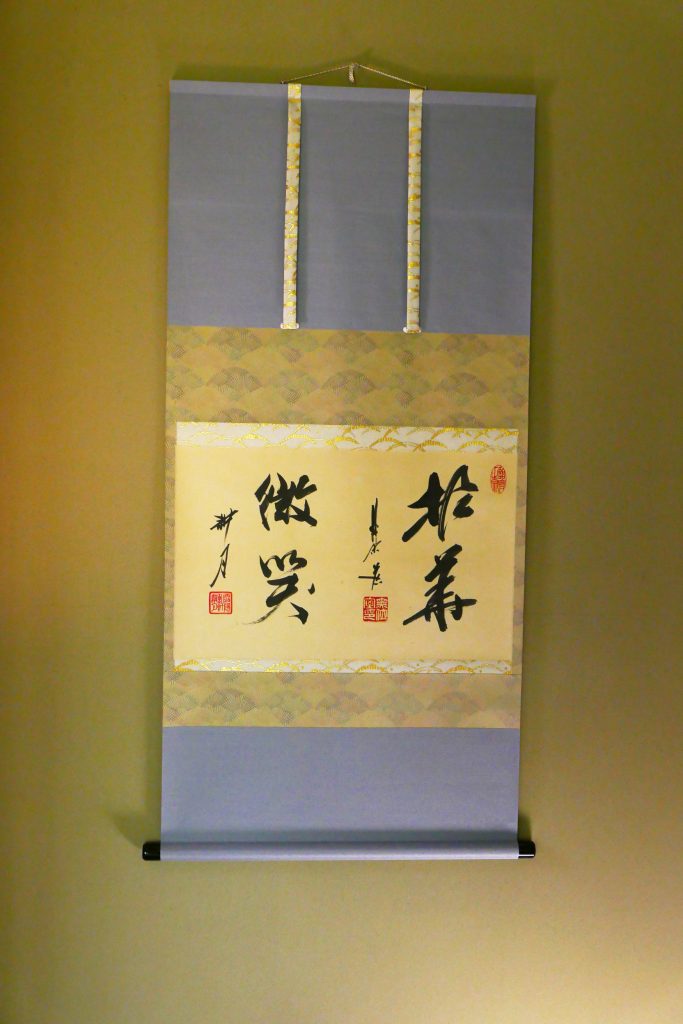
It reads, “Holding up a flower. Subtle smile.”
The space returns to its vibrancy, its depth of purpose. This is no ordinary space, it is a place that confirms and supports truth. The gold thread sewn into the cloth mounting around the white paper of the calligraphy shimmers in the shadows of the early evening.
I weep for the intensity of my training practice. My life. Now more ordinary without my teacher.
But when I hang this calligraphy of his, his spirit comes alive as he was, and it says, this is the way and I offer it to you, ordinary yet beyond time and place.
Ranjatai Incense
I searched all over Kyoto to find the same incense that had been given to me years before on my birthday. The delicate fragrance had scents of sandlewood, spices of cinnamon and clove, and camphor.
In the practice of tea, incense is prized and at some tea gatherings the host will bring out various incense for the guests to appreciate. It’s called “Listening to incense.”
The most highly prized and rare incense is called Jin-koh, also called Agarwood, that comes from Southeast Asia. It’s literally worth it’s weight in gold. Agarwood forms when Aquilaria trees become infected with mold and the tree develops a resin to protect itself. This resin forms in the heartwood of the tree and is what is prized as Agarwood or Aloeswood.
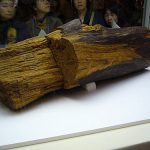
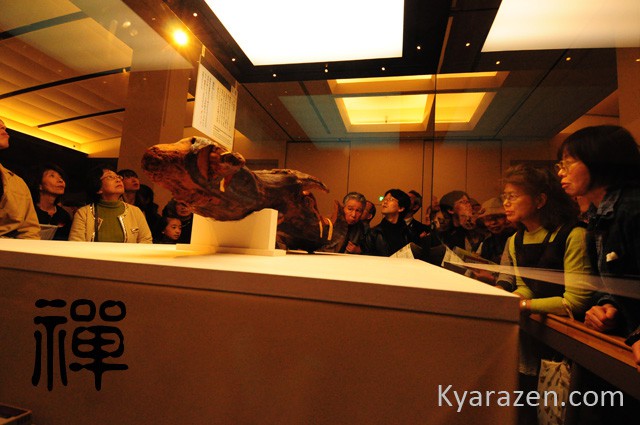
The largest piece of Jin-koh in Japan was given to Emperor Shomu (AD 724-748) as a tribute from China. It has been kept in the Imperial treasure repository since that time. It is named Ranjatai and is the most famous chunk of wood on the planet. It weighs 11.6 kilograms and is 1.56 meters long.
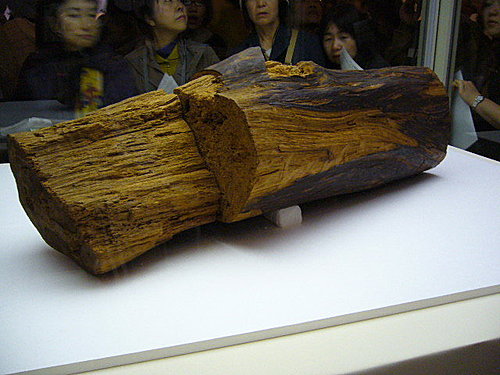 For the past millennium, only a few small pieces have been cut from the Ranjatai.
In 1465, one small piece was ordered by Emperor Gotsuchimikado as a gift to Shogun Ashikaga Yoshimasa. In 1574, a small piece was given from Emperor Oogimachi to general Oda Nobunaga for his efforts in unifying Japan, In 1602, Shogun Tokugawa Ieyasu, who was powerful and influential enough, obtained a piece, and in 1877, Emperor Meiji asked for a piece.
That’s how coveted this piece of wood is.
Nobunaga kept his small piece and then gave fragments of it to two guests who came for a tea gathering. This gift demonstrated his cultural superiority and power. The two guests received Ranjatai fragments presented on open fans. The fans were decorated with cut gold foil.
Every ten years Ranjatai is brought out of the treasury repository and exhibited. People line up for hours to view it – the most famous piece of incense in the world.
Red Hot Stove
On the red hearth, one flake of snow
I love the image of a flake of snow that’s landed on the red hot stove. Gone in an instant. This phrase is from a koan in the Blue Cliff Collection, Case 69 Nansen Draws a Circle.
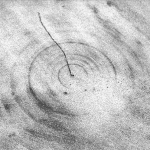
Three Zen friends were on their way to pay respects to the National Teacher. At one point they stopped, and Nansen drew a circle on the ground and said, “If you can speak, we’ll go on.” The story tells the various responses from his friends.
What I love about this story is the introduction to the koan by Engo. He says, “Patchrobed monks who have passed through the forest of prickly briars are like snow on a red hot oven.”
The briars and thickets are my likes and dislikes, my questioning of right and wrong, good and bad.
In Japanese the phrase is”Koro itten no yuki.” Here it is on a scroll.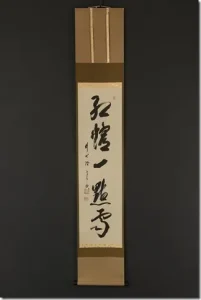
Yamada Koun commentary:
“The forest of prickly briars” refers to our own concepts and thoughts which catch us up constantly, depriving us of our freedom. Man may be “the measure of all things” because our ability to think gives us supposed dominion over the rest of nature. But, from another standpoint, this very ability to think is the source of all our suffering.
The patchrobed monks (it need not be just monks!) who have passed through this forest of prickly briars (through the practice of Mu or Shikantaza, for example) are “like snow on a red hot stove.” If a pinch of snow were placed on a red hot stove, it would immediately melt and evaporate. In the same way, when you stand up, there is just that standing, with nothing else remaining.
All other concepts have disappeared like snow on a red hot stove.
And when you sit down, there is just that sitting, without a trace of standing left over.
Every moment of our lives is like this. Just that moment.
Each second disappears like snow on a red hot oven. Standing, sitting, eating, sleeping, laughing, crying.
The content is always completely empty.
Dai Bosatsu Zendo

Sei Shonagon wrote this poem and it makes me think of Dai Bosatsu monastery.
“Count each echo of the temple bell
As it tolls in the evening by the mountain’s side.
Then you will know how many times
My heart is beating out its love for you.”
That’s me on the left. Morning service with the Roshi at Dai Bosatsu so many years ago.